Translate

Showing posts with label Fortresses. Show all posts

Mar 18, 2018

The Cannons of Faial

Image result for fortim faial


Built in the early twentieth century, the area in which ten cannons keep watch was never considered a fortress, but rather a local watch against invaders, or gazebo for visitors. It is a simple recreation of a military battery which includes ten eighteenth century English cannons. The cannons belonged to Mr. João Catanho Meneses (1854-1942) who was a famous politician and lawyer who served under the Progressive Party of the early twentieth century. The cannons were originally from British ships which were eventually dismantled. The cannons were left abandoned along the northern coast of Madeira’s coastline until the Meneses Family decided to collect them all and gather them up in their estate. It became a tradition to fire the cannons during the festivities dedicated to Our Lady of the Nativity. In due time, the government forbade the firing of such weapons due to the fact that it was regarded as a security threat.  The cannons were eventually turned over to the jurisdiction of the Regional Directorate of Cultural Affairs and recognized as a ‘cultural heritage’ by the local government in 1996.
As a tourist and local attraction the fortress area provides breathtaking views of a large stretch of the coastline, the center of Faial and, on clear days, Porto Santo, the Serra da Penha d' Águia and the northern part of Ponta de São Lourenço.

May 10, 2013

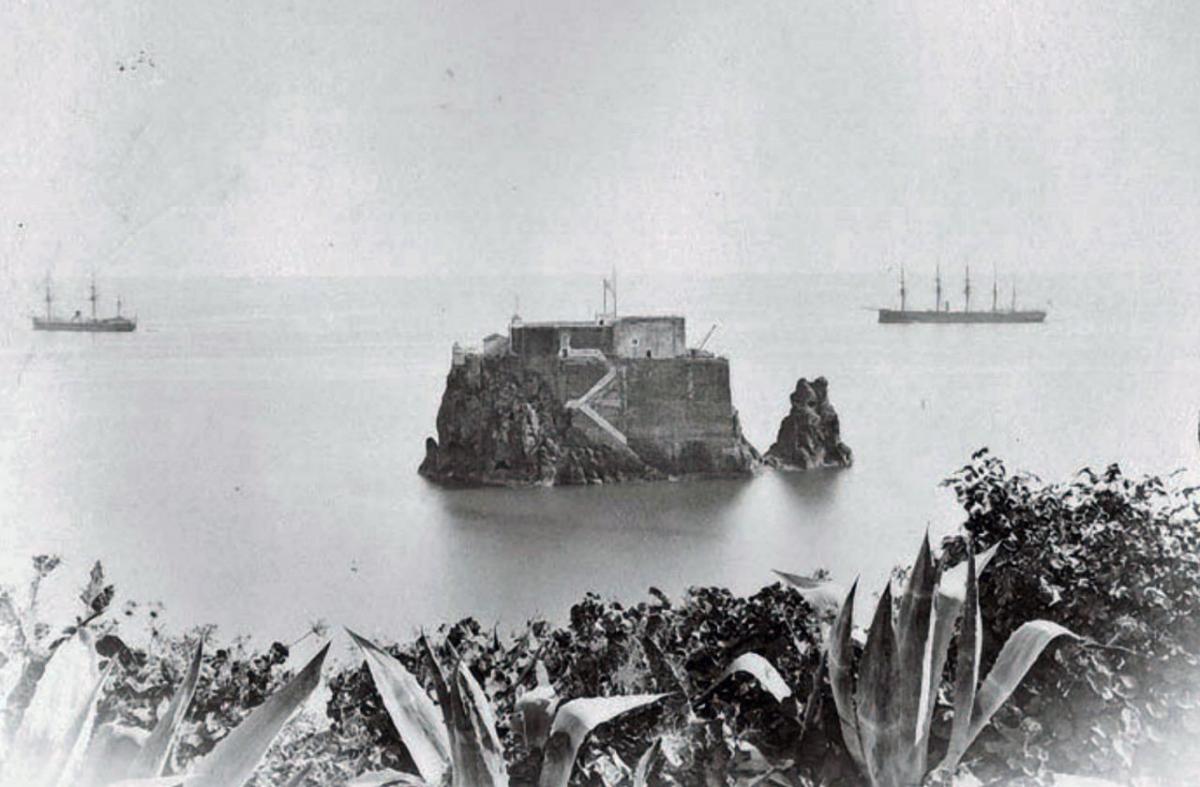
Ilheu de Nossa Senhora da Conceição


MOLHE Club is located in an old military fortress at the top of the islet called Molhe da Pontinha, a rock that rises more than 60 meters above the waters of the Atlantic Ocean into the Funchal bay.
Upon the discovery of Madeira island in 1419, mariners and sailors set up a camp in two small islets west of the bay, the islet "São José" and the islet "Nossa Senhora da Conceição", now known as "Ilhéu do MOLHE da Pontinha".
The Fortress MOLHE, began to be built in the early seventeenth century, between 1634 and 1636, the largest of these islets to defend the island against the constant attacks of pirates. It was inaugurated in 1654.
In 1682 a chapel was built in the fortress in honor of "Nossa Senhora da Conceição", the reason for the fortress be named "Ilhéu de Nossa Senhora da Conceição".
In 1771 was projected the union of the two islets, having been built in 1776, connecting the islet "São José", and a century later, in 1888, completed the connection between the two islets, and the islet "Nossa Senhora da Conceição" left to be isolated with the construction of MOLHE da Pontinha.
After more than 300 years from service to the military functions,MOLHE da Pontinha was opened to tourism and adapted to the functions of bar and restaurant in 1996. Ten years later, in 2006, a careful restoration to the existing functions and Restaurant Club was made.
MOLHE Club offers three different spaces, with different music, TERRACE Club, HOUSE Club and MICRO Club, besides the restaurant on the top of the building offering a truly stunning view of Funchal bay and Atlantic Ocean.
With new management since 2010 MOLHE Club has led the nightlife in the city of Funchal, in Madeira, and is now a national and international, featuring an innovative multimedia center that can be visited at www.molhe.com and more than 20,000 fans on our page
www.facebook.com/molhe.


Nov 10, 2012

Fort of Our Lady of Amparo

Image result for forte nossa senhora do amparo


The Fort of Our Lady of Amparo is located in the heart of Machico, a city and municipality in the northeastern part of the island.
The fort was built in 1706 at the expense of Captain Francisco Dias Franco registrar of the Board of Machico. It served to protect the area from pirate attacks.
With the proclamation of the Portuguese Republic in1910 the Crown Coat of Arms was removed from its gate.
In 1940 the property was handed over to the Border Guard of National Security.  
In 1993 it was donated to the Regional Government of Madeira and has since been used as a tourist information centre.


Sep 18, 2012

Fort of Saint John the Baptist


The Fort of Saint John the Baptist, otherwise known as the Peak Fort, stands high up above Funchal at approximately 110 meters in altitude.
Built in 1602, it was the city's main defence against the many pirate attacks which took place during that time. Its location was decided upon not only because of its geographical position in relation to Funchal and its coastline, but also because of the fresh water supply which existed there.
The fort was originally made of timber, but eventually it was replaced by stone. It took many years to
improve the structural integrity of the stone-made fortification. Its main gate reads 1632.
While cannons were placed there in 1742, there is no record of major military conflict related to the fort. In fact, in the mid-eighteenth century, it served as a gunpowder warehouse and prison. Later, in the 1770s, it was used to train young men in various trades. After the floods of 1803, tents were placed in its interior to accommodate families who had been temporarily homeless.
Its name originated from the chapel which stood on the same land which was used to construct the fort. The chapel was originally built to honour St. John.
In the 20th century, many antennas were installed for what was to become a military radiotelegraph station. Accordingly, locals affectionately began to call the fort ‘Pico Radio’ (Radio Peak). It has, since then, served as a naval communications center.
The fort also houses a small museum which displays drawings and photographs related to the history of Funchal and the fortress itself.

May 6, 2012

Fort of São Tiago


The Fort of São Tiago was built in 1614 to defend the city, and was named after the patron saint of Funchal, St James the Less. There were additions in 1746 and the fort has been restored and now houses the Museum of Contemporary Art, which opened in 1992. The fort is a maze of passages and staircases and offers fine views over Funchal, it also has an agreeable restaurant.
Fort Sao Tiago museum has a great collection of Portuguese art, dating back to the 1960s. This museum has been open to the public since 1992 and is considered to be one of the top 5 museums in Portugal. It also promotes and hosts private exhibits from several artists and institutions.

Mar 9, 2012

Palácio de São Lourenço

photo: Zita Abreu

Funchal’s first fortress was built between 1529 and 1540 on a plea by the population of Funchal after a vessel, moored in the harbour of Funchal, had been pillaged. The fortress served as the official residence for many captains and governors of the island. Unfortunately, the fort failed as a safehold seeing that it was succumbed easily to the attacks of the French pirates in 1566. The years which followed involved further development or advancement on the defensive structure: many improvements, alterations and extensions to the original construction were made. In August 1943, it was classified as a National Monument. In July 1993 an exhibition, which is currently housed in the fortress itself, was opened to the public. The exhibition traces the history and development of the fortress. Today, the Palácio de São Lourenço is one of the best-preserved Portuguese fortifications from the 16th  century. It serves as the residence for the head of the Autonomous Region and Military Command.