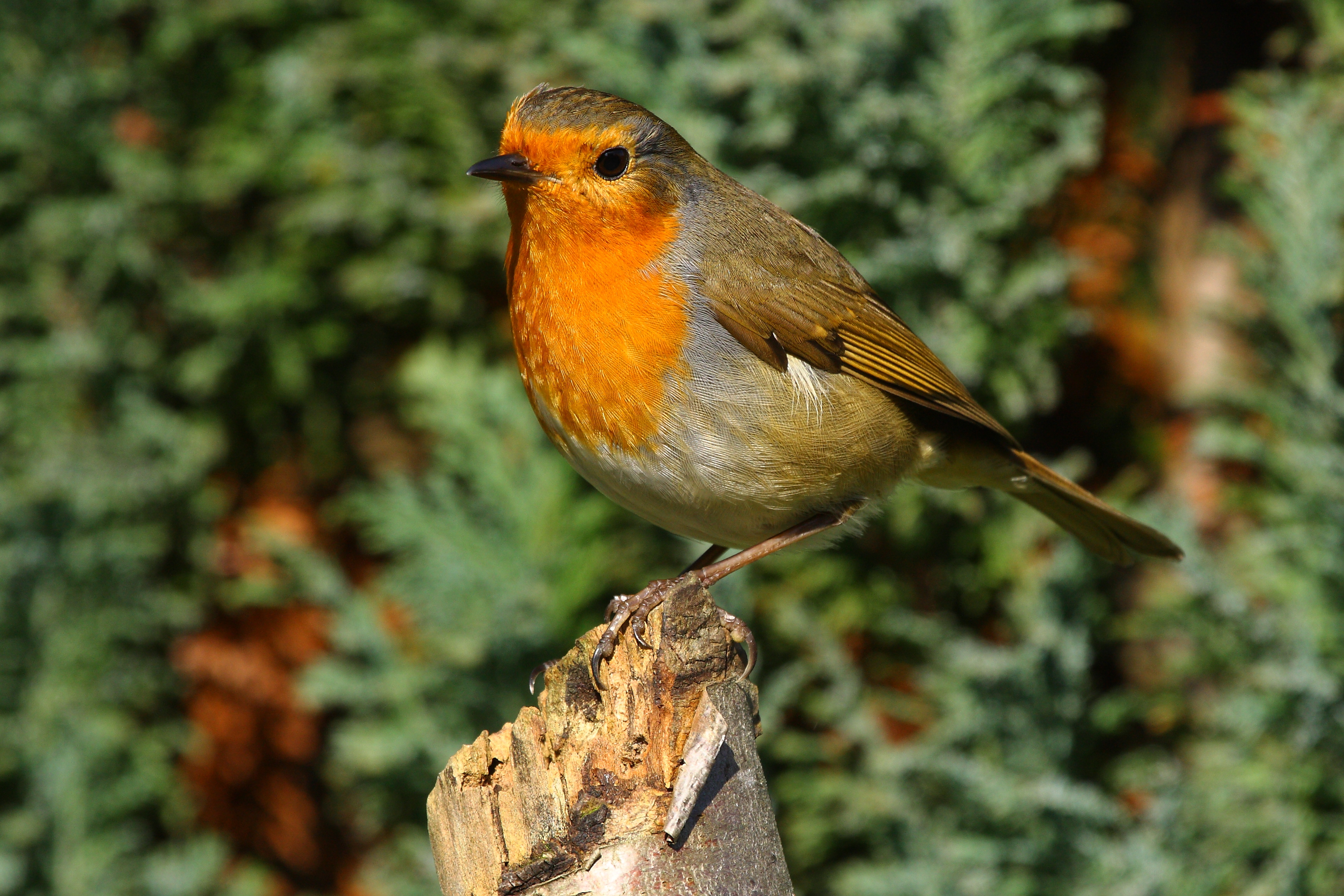
Madeirans call
it Papinho, others simply refer to it
as Robin, or Robin Redbreast in the British Isles. Scientists refer to it as Erithacus
rubecula. What is it?
It is a
small insectivorouspasserine bird,
specifically a chat,
considered to be an Old World flycatcher.
Taxonomy ...
The robin
belongs to a group of mainly insectivorous birds
that have been variously assigned to the thrushes or "flycatchers",
depending on how these groups were perceived taxonomically.
Eventually, the flycatcher-thrush assemblage was re-analysed and the
genus Erithacusassigned to a group of thrush-like true flycatchers,
the tribe Saxicolini, that also includes the common nightingale and the Old World chats.
Description ...
The adult European robin is 12.5-14.0 cm (5.0-5.5 in) long and
weighs 16-22 g (9/16-13/16 oz), with a wingspan of 20-22 cm (8–9 in). The male and female
bear similar plumage; an orange breast and face (more strongly coloured in the
otherwise similar British subspecies E. r. melophilus), lined by a
bluish grey on the sides of the neck and chest. The upperparts are brownish, or
olive-tinged in British birds, and the belly whitish, while the legs and feet
are brown. The bill and eyes are black. Juveniles are a spotted brown and white
in colouration, with patches of orange gradually appearing.
Distribution & Habitat
The robin
occurs in Eurasia east to Western Siberia,
south to Algeria and
on the Atlantic islands
as far west as the Azores and Madeira. Irish
and British robins are largely resident but a small minority, usually female,
migrate to southern Europe during
winter, a few as far as Spain. The robin prefers spruce woods in northern
Europe, contrasting with its preference for parks and gardens.
Behaviour & Ecology
The robin
is diurnal,
although has been reported to be active hunting insects on moonlit nights or
near artificial light at night. It is relatively unafraid of people and
drawn to human activities involving the digging of soil, in order to look out
for earthworms and
other food freshly turned up. Indeed, the robin is considered to be a gardener's
friend and for various folklore reasons
the robin would never be harmed. Robins also approach large wild animals, such
as wild boar and
other animals which disturb the ground, to look for any food that might be
brought to the surface. In autumn and winter, robins will supplement their
usual diet of terrestrial invertebrates, such as spiders, worms and insects,
with berries and fruit. They will also eat seed mixtures placed on bird-tables.
Because of
high mortality in the first year of life, a robin has an average life expectancy of
1.1 years; however, once past its first year it can expect to live longer
and one robin has been recorded as reaching 19 years of age. A spell
of very low temperatures in winter may also result in significant mortality. This
species is parasitised by the moorhen flea, Dasypsyllus
gallinulae.
Breeding ...
Robins may choose a wide variety of sites for building a nest. In fact,
anything which can offer some shelter, like a depression or hole may be
considered. As well as the usual crevices, or sheltered banks, other objects
include pieces of machinery, barbecues, bicycle handlebars, bristles on
upturned brooms, discarded kettles, watering cans, flower pots and even hats.
The nest is composed of moss, leaves and grass, with fine grass, hair and
feathers for lining. Two or three clutches of five or six eggs are laid
throughout the breeding season, which commences in March. The eggs are a cream,
buff or white speckled or blotched with reddish-brown colour, often more
heavily so at the larger end. When juvenile birds fly from the nests they are
mottled brown in colour all over. After two to three months out of the nest,
the juvenile bird grows some orange feathers under its chin and over a similar
period this patch gradually extends to complete the adult appearance.

No comments:
Post a Comment