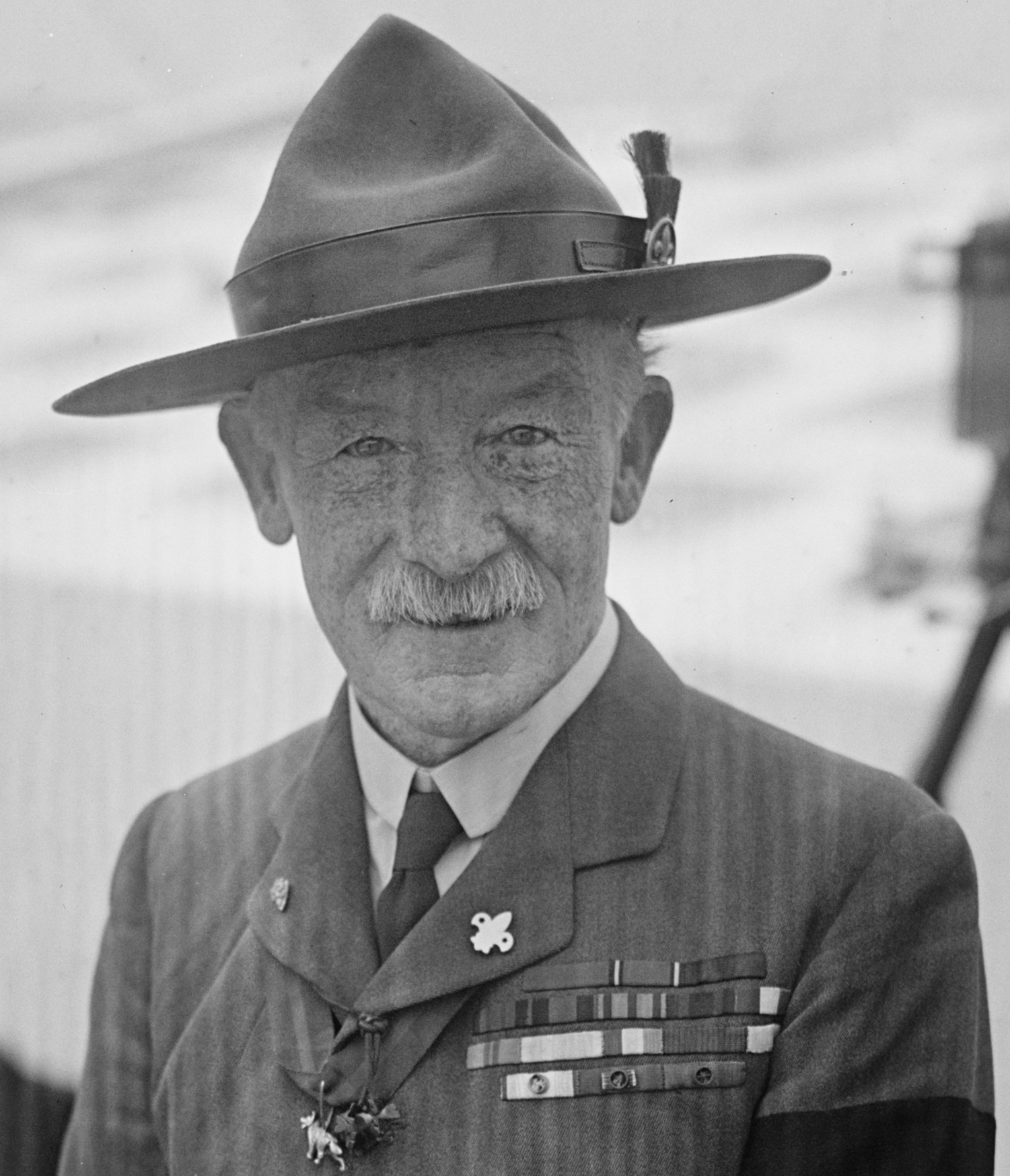
Lieutenant
General Robert Stephenson Smyth Baden-Powell, 1st Baron Baden-Powell (22
February 1857 – 8 January 1941), also known as Lord Baden-Powell, was a British
Army officer, writer, author of Scouting for Boys which was an inspiration for
the Scout Movement, founder and first Chief Scout of The Boy Scouts Association
and founder of the Girl Guides.
After having
been educated at Charterhouse School in Surrey, Baden-Powell served in the British
Army from 1876 until 1910 in India and Africa. In 1899, during the Second Boer War in
South Africa, Baden-Powell successfully defended the town in the Siege of Mafeking.
Several of his military books, written for military reconnaissance and
scout training in his African years, were also read by boys. In 1907, he held a
demonstration camp, the Brownsea Island Scout camp, which is now seen as the
beginning of Scouting. Based on his earlier books, he wrote Scouting for Boys,
published in 1908 by Sir Arthur Pearson, for boy
readership. In 1910 Baden-Powell retired from the army and formed The Boy Scouts Association.
The
first Scout Rally was held at The Crystal Palace in 1909, at which appeared a number of girls
dressed in Scout uniform, who told Baden-Powell that they were the "Girl
Scouts", following which, in 1910, Baden-Powell and his sister Agnes Baden-Powell formed the Girl Guides from
which the Girl Guides Movement grew. In 1912 he married Olave St Clair Soames. He gave guidance to the Scouting and Girl Guiding
Movements until retiring in 1937.
Baden-Powell
made paintings and drawings almost every day of his life. Most have a humorous
or informative character. He published books and other texts during his years
of military service both to finance his life and to educate his men.
Baden-Powell
was regarded as an excellent storyteller. During his whole life he told
"ripping yarns" to audiences. After having published Scouting
for Boys, Baden-Powell kept on writing more handbooks and educative
materials for all Scouts, as well as directives for Scout Leaders. In his later
years, he also wrote about the Scout movement and his ideas for its future. He
spent most of the last two years of his life in Africa, and many of his later
books had African themes. Currently, many pages of his field diary, complete
with drawings, are on display at the National Scouting Museum in Irving, Texas.
Baden-Powell
was keen on amateur theatricals, from Charterhouse public school where among
other roles he played female operatic roles. In the army he made a speciality
of female roles and would often make his own dresses. His stage specialty was
what he called his skirt dance.
On
July 9, 1931, Robert Baden-Powell visited Madeira. Received by the regional government,
he left behind his message to the regional scouts of Madeira – “I am delighted
with the appearance and discipline of the scouts of Madeira and I wish them
success and blissful camping.” A bust, sculpted by Ricardo Jorge
Abrantes Velosa, was placed near the Sé Cathedral in 1998 to honour
Baden-Powell.
Baden-Powell
lived his last years in Nyeri,
Kenya, where he died and was buried on January 8, 1941. He is buried at St. Peter's Cemetery in Nyeri.His gravestone bears a
circle with a dot in the centre "ʘ", which is the trail sign for
"Going home", or "I have gone home". His wife Olave moved
back to England in 1942, although when she died (in 1977), her ashes were sent
to Kenya and interred beside her husband. The Kenyan government has
declared Baden-Powell's grave a national monument.

No comments:
Post a Comment