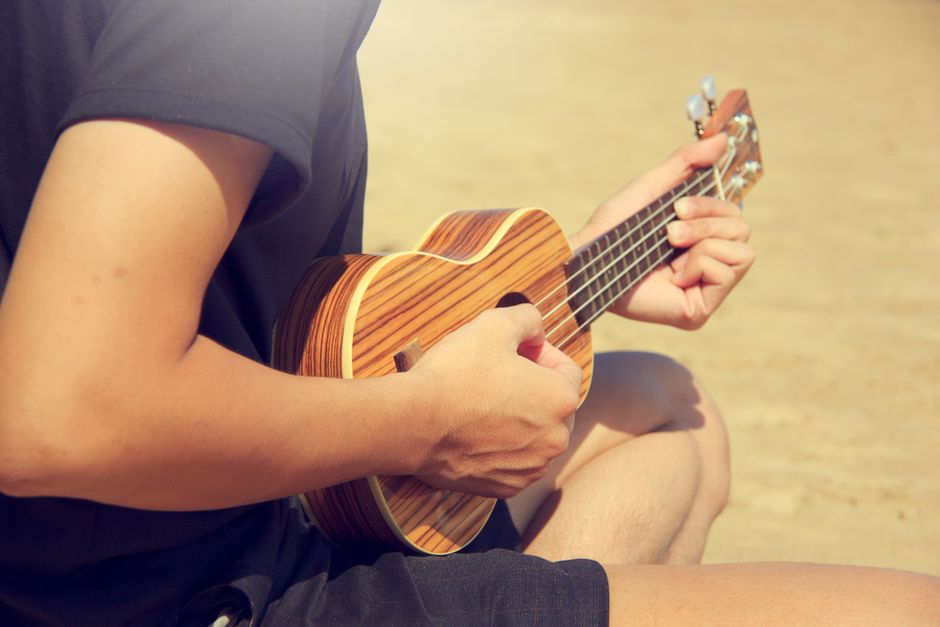
The author of the article The Birth of the Ukele is an
avid ukulele collector and woodworking expert residing in Santa Cruz,
California. The following excerpt
includes a brief account of the birth and maturity of the Ukelele.
“When did the
Hawaiians invent the ukulele?” a friend of mine asked as I was giving her a
tour of my collection of 430-plus vintage ukes.
The belief
that Hawaii lays sole claim to the ukulele—the instrument that would seem to
have grown up over centuries in relative obscurity among the descendants of the
Polynesians—is a widely held misconception, and one that I’ve often been
obliged to dispel. In fact, I informed her, the earliest ukes only date back to
the mid-1880s. Then, pausing for effect, I added: “And they weren’t
invented by the Hawaiians.” Looking like a six year old who has learned
that Santa Claus doesn’t exist, my confused friend furrowed her brow and
considered the ukuleles hanging on my wall anew. True, the actual history
of the ukulele begins on an island, but not one in the Hawaiian chain, nor one
in the Pacific Ocean, for that matter. Madeira, a small mountainous speck of
land in the Atlantic southeast of Portugal, about a 350-mile swim from the
coast of North Africa, is the actual birthplace of the beloved uke.
Two
centuries ago, ... visitors were often entertained by music played in the
streets of Funchal, the island’s bustling port city. Because there were no
encased windows on the houses in this hot climate, it must have been difficult
to not hear strains of music, both day and night. Local
musicians strummed waltzes, mazurkas, and folk tunes on the Spanish guitar and
a small, guitar-like, four-string instrument called the machête ... , also
known as the braguinha or the “machéte de Braga” after the city in northern
Portugal where the instrument originated. Unfortunately, by the mid 1800s, ... poverty,
famine, and a series of natural disasters that led to the collapse of the wine
industry made the island a better place to escape from than to. Scores of
unemployed Madeirans sought to leave their overcrowded homeland and launch a
new life elsewhere. It just so happened that as things were going wrong in
Madeira, life was flourishing half a world away, in the Sandwich Islands - as
the Hawaiian Islands were commonly known then - where the sugar industry was
booming. ... Among the more than 25,000 Madeirans who came to Hawaii in the
late 1800s, there were three woodworkers from Funchal: 40-year-old Manuel
Nunes, 37-year-old Augusto Dias, and 28-year-old Jose do Espirito Santo.
Joined by their families, the men packed aboard the 220-foot-long British
clipper ship SS Ravenscrag, and embarked on the arduous four-month-long, 12,000
mile ocean journey to Oahu. Little did they know that this new adventure would
not only bring them prosperity, but would lead to the creation of a new
instrument.
The poor,
sea-weary immigrants finally arrived in Honolulu Harbor on a quiet Saturday in
August of 1879. ... Just a couple of weeks after (their) arrival, the following
item ran in the Hawaiian Gazette on September 3, 1879:
“…Madeira Islanders recently arrived here have been delighting the people with nightly
street concerts. The musicians are fine performers on their strange
instruments, which are a kind of cross between a guitar and a banjo, but which
produce very sweet music in the hands of the Portuguese minstrels.”... Dias set
up his own small woodworking shop in 1884. ... He made not only furniture, but
also musical instruments.... Within a year, Nunes had opened his own shop just
three blocks away. ... Santo soon followed suit, opening his shop just a few
doors down from Nunes. ... Despite their lack of formal lutherie training, it’s
clear from the quality of the instruments they built that these Madeirans knew
what they were doing. ... All three woodworkers built machêtes that looked a
lot like ukuleles, and Santo advertised that he could “make guitars of all
sizes.” Nunes claimed that he had invented the ukulele, boldly
announcing this in newspaper ads and on his instrument labels. ... Whatever
part Nunes or Dias or Santo may have had on the creation of the uke, it’s most
likely that the first true ukuleles were hybrid instruments: a mash up of the
machête and another smallish Portuguese instrument, the five-string rajão. The
petite size and body outline of the machête, as well as its 17-fret fingerboard
provided the basis for the ukuleles’ overall shape and configuration. ... Another
important element that distinguishes Hawaiian ukuleles from their Portuguese
brethren is the material they’re made from. Machétes and rajãos are typically
built with spruce tops and bodies made of juniper and other light woods.
Virtually all early ukuleles were made entirely from koa, a golden honey-brown
wood prized by the Hawaiians and traditionally used for furniture and all
manner of quality goods. Ukuleles, such as the one made by Jose do Espirito
Santo, were, by and large, crafted from highly figured koa, and often had the
same kinds of ornate decorations found on machêtes.
Hawaii actually
had the word “ukulele” before they had the instrument. An 1865 dictionary
defined the word as “a cat flea,” a pest that had found its way to the islands
decades earlier. ... Whatever the exact etymology of the word, the appeal for
the instrument spread quickly, thanks, in part, to one of its earliest
champions: David Kalakaua, Hawaii’s last king. Kalakaua, his Queen Emma, and
the future queen Lili’uokalani (who composed “Aloha Oe,” that most sacred of
Hawaiian songs) were all accomplished musicians and patrons of the arts. Their
support and promotion of the ukulele encouraged other Hawaiians to take up the
instrument and develop their own music and styles.
By 1900,
Santo had closed his shop, but continued to work at home for a few more years
before he died. Dias lost his shop in a devastating fire that destroyed much of
Honolulu’s Chinatown that same year. Nunes, the most prolific luthier of the
three, continued building instruments for many years. He taught the art of
ukulele making to numerous craftsmen, including his son Leonardo, who ran the
Nunes factory in Los Angeles until 1930. Another of Manuel’s apprentices,
Samuel Kamaka, started his own one-man shop in 1916. Now, nearly 100 years
later, the Kamaka Ukulele and Guitar Works on South Street in Honolulu carries
on the legacy of three Portuguese emigrants who forever changed Hawaiian music
and gave the world the gift of the “jumping flea.”

No comments:
Post a Comment