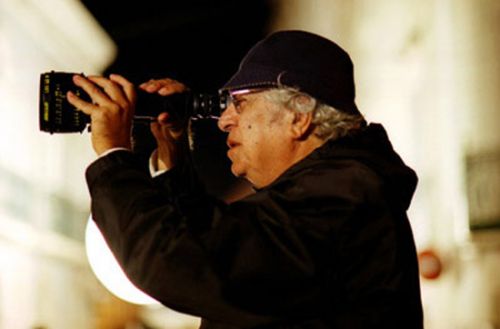
António
Cohen da Cunha Telles is a Portuguese film director and producer. He was born on February 26, 1935 in Funchal, Madeira.
He studied Medicine at the University of Lisbon. He went to Paris in 1956 where he studied
film-making at the Institut des Hautes Etudes Cinematographiques (IDHEC). He
graduated in 1961 and returned to Portugal
where he ran a newspaper called Imagens
de Portugal (Images of Portugal) and was administrator for the Cinema
Services of State Entities.
His directing career
debuted with the documentary Os
Transportes (1962). Soon
afterwards he became one of the top names of the Portuguese New Cinema (Novo
Cinema) movement.
He produced Os Verdes Anos (1963) by Paulo
Rocha and Belarmino (1964) by Fernando
Lopes.
In 1970, Cunha
Telles directed his first feature-film, O Cerco.
Meanwhile, he established a distribution company called Animatógrafo that was
responsible for a revolutianary new type of cinema as never before seen in
Portugal. Eisenstein, Tanner, Jorge
Sanjines, Littín, Glauber
Rocha, Vigo, Gilles
Carle, Karmitz,
among others, became popular names in Portuguese cinematography
thanks to Cunha Telles.
During the
1970s Telles directed three films: Meus
Amigos (1974), Continuar a
Viver (1976)
and As Armas e o
Povo (1975).
By the end of the decade, Cunha Telles was heading the Portuguese
Cinema Institute and
Tobis Portuguesa.
Eventually,
Cunha Telle’s distribution company ended
up being divided into two branches: a distribution division headed by Renée
Gagnon presently called Marfilmes, and a production division currently called Filmes de
Fundo headed by Cunha
Telles and his daughter Pandora da
Cunha Telles. Filmes
do Fundo is committed to Telles’ own productions as well as production of foreign
films, which are partially shot in Portugal. The most recent films directed by
Cunha Telles are Vidas (1984), Pandora (1996) and, more recently, Kiss Me (2004).
As
a producer and co-producer, Cunha Telles is responsible for more than 200
titles and has earned an Oscar for Portuguese Cinema History - "Belle
Epoque" by Fernando Trueba and an Academy Award for Best Foreign Picture.

No comments:
Post a Comment