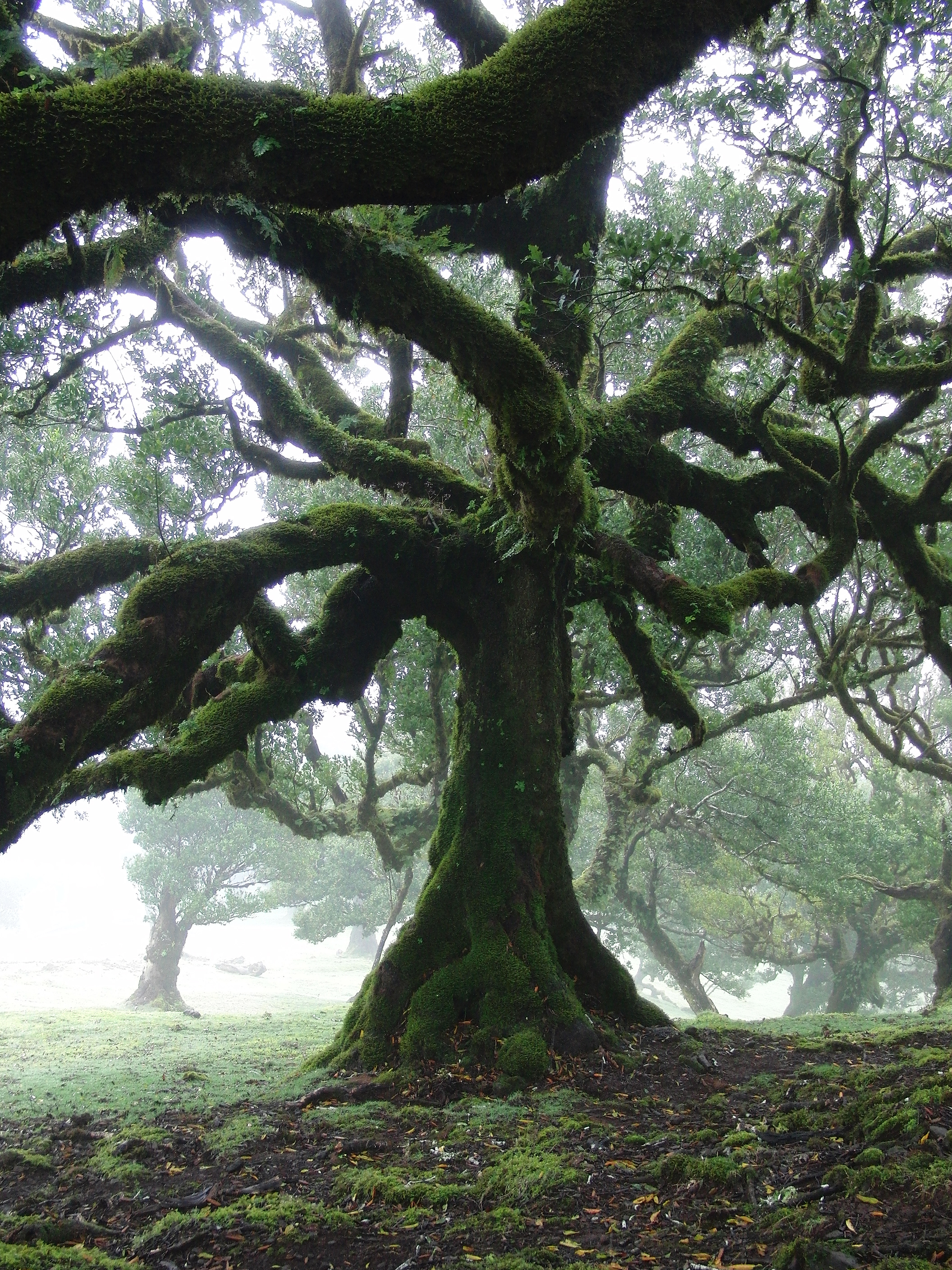
Ocotea foetens, commonly called til, tilo, stinkwood, or rain
tree of Hierro island, is a species of tree in
the Lauraceaefamily. It is evergreen and grows up
to 40 m tall. It is a common constituent of the laurisilva forests of Madeira and the Canary Islands. It is in
danger of becoming threatened due to habitat loss.
Description
Ocotea foetens is endemic to Macaronesia. Like the
other species of the Ocotea genus,
it is rich in essential oils, which give an unpleasant odor to the wood when
freshly cut (hence the name foetens, Latin for smelly, stinky, disgusting, unpleasant).
It is rarely used as an ornamental. It is an evergreen tree generally up to 30 m
(33 yd) in height, although some specimens may reach 40 m
(44 yd). It commonly grows with multiple trunks branched from the base.
The bark is rough and irregular, and dark in colour; the young branches are
angular, with smooth bark, sometimes reddish in areas of recent growth.
The wood is dark and hard. The leaves are about 9–12 cm
(3.5–4.7 in) long and 3–5 cm (1.2–2.0 in) wide, oblong-lanceolate to
almost elliptical, acuminate at the apex and slightly indented at the base. In
adult plants, the leaves are leathery in texture, glossy on both sides, darker
green on the upper surface, with 2(-4) small gland-like depressions on the
underside near the base. The petioles are
short (up to 15 mm (0.59 in) in length). The flowers of both
sexes are white, with splashes of green and pale yellow, releasing a slight
odor. The perianth has six
components, and there are nine stamens. The predominant flowering season is
from June to August (northern hemisphere). The fruit is a berry, hard and
fleshy and about 3 cm (1.2 in) long, its lower half covered by a
dome, giving it a look similar to an acorn. The fruit is dark green,
gradually darkening with maturity. The fruit has a single seed wrapped in a
hard coat. When the fruits fall they separate from the dome. Germination is
favored by moisture and light.
Ecology
Ocotea foetens is endemic to Madeira and the Canary Islands, appearing in
laurel forest habitat, generally between 400 and 1400 m altitude. In the Canary
Islands it is not present on Lanzarote or Fuerteventura. In the
archipelago of Madeira it is absent from Porto Santo. In Azores Islands it is
an introduced species. It is the only Paleoendemic Ocotea species in the wetter relict forest areas of
Macaronesia. Its berries are consumed mostly by the endemic Madeiran pigeon Columba
trocaz.
Folklore
Ocotea foetens was
sacred to the Bimbaches, the older
inhabitants of El Hierro in
the Canary Islands, and was one
of their symbols. The legend states that the "Garoé" was a large
laurel tree that assured the life of the Bimbaches, providing them with water
in sufficient amounts for their survival. The islands are located where
tradewinds occur, and water from clouds condensed on the branches of the tree
and it later poured rain around the island. One of many legends says that
the water originating from the tree was led to a hole from which the Bimbaches
could provide water. The original tree fell in a storm in 1610. In 1957, a replacement was
planted in the same location as the Garoé. It has been growing and is surrounded by mosses.

No comments:
Post a Comment